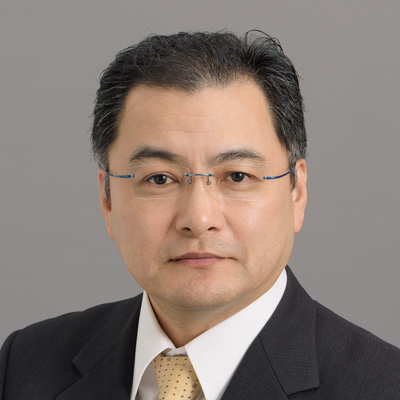
KATAYAMA, Yasushi

写真a

Affiliation

Faculty of Science and Technology, Department of Applied Chemistry ( Yagami )

Position

Professor

E-mail Address

E-mail address

Related Websites

External Links

Career 【 Display / hide

  • 1996.04
    -
    2001.03

    慶應義塾大学(理工学部) ,助手

  • 2001.04
    -
    2007.03

    慶應義塾大学(理工学部) ,専任講師

  • 2003.09
    -
    2004.09

    Guest researcher, RWTH Aachen, Germany

  • 2007.04
    -
    2014.03

    慶應義塾大学(理工学部) ,准教授

  • 2014.04
    -
    Present

    慶應義塾大学(理工学部) ,教授

Academic Background 【 Display / hide

  • 1991.03

    Tohoku University, Faculty of Engineering, Nuclear Engineering

    University, Graduated

  • 1993.03

    Kyoto University, Graduate School of Engineering, Divition of Nuclear Engineering

    Graduate School, Completed, Master's course

  • 1996.03

    Kyoto University, Graduate School of Engineering, Division of Nuclear Engineering

    Graduate School, Completed, Doctoral course

Academic Degrees 【 Display / hide

  • Dr. Eng, Kyoto University, Coursework, 1996.03


Research Areas 【 Display / hide

  • Manufacturing Technology (Mechanical Engineering, Electrical and Electronic Engineering, Chemical Engineering) / Electron device and electronic equipment (Functional Materials/Device)

  • Nanotechnology/Materials / Inorganic compounds and inorganic materials chemistry (Inorganic Industrial Material)


Books 【 Display / hide

  • The Latest Trend of the Development and Implementation of Ionic Liquids

    片山 靖, 2022.08

  • Lithium Metal Anode

    Tachikawa N., Serizawa N., Katayama Y., Next Generation Batteries: Realization of High Energy Density Rechargeable Batteries, 2021.01

     View Summary

    Deposition and dissolution of lithium metal have been investigated in an equimolar mixture of lithium bis(trifluoromethylsulfonyl)amide (LiTFSA) and glyme [triglyme (G3) or tetraglyme (G4)] solvate ionic liquid. The limiting current for deposition of lithiumwas not observed probably because of the high concentration of lithium species and a decrease in the local viscosity by the liberation of glyme. On the other hand, the dissolution of lithium was limited due to an increase in the local viscosity by the formation of [Li(TFSA)2]–. The formation of solid electrolyte interphase (SEI) was suggested to form by the cathodic decomposition of the solvate ionic liquids by electrochemical quartz crystal microbalance. Lithium phosphorous oxynitride (LiPON) thin film was found to act as the artificial SEI, which prevented the cathodic decomposition of the solvate ionic liquids and enabled the deposition and dissolution of lithium. The cycle performance of deposition and dissolution of lithiumwas found to be improved by coating a Cu substratewith vapor-grown carbon fiber.

  • Development Trend of Redox Flow Battery

    KATAYAMA YASUSHI, シーエムシー出版, 2017.09

  • イオン液体研究最前線と社会実装

    KATAYAMA YASUSHI, シーエムシー出版, 2016

  • Nanocatalysis in Ionic Liquids

    KATAYAMA YASUSHI, Wiley-VCH, 2016

display all >>

Papers 【 Display / hide

  • The Local Changes in the Physicochemical Properties during Electrode Reactions in a Chlorocuprate Ionic Liquid

    Serizawa N., Kuwahara S., Li X., Katayama Y.

    Journal of the Electrochemical Society 172 ( 4 )  2025.04

    ISSN  00134651

     View Summary

    The physicochemical and electrochemical properties of an ionic liquid consisting of the dichlorocuprate anion, [CuCl<inf>2</inf>]<sup>-</sup>, were investigated. The equimolar mixture of CuCl and 1-butyl-1-methylpyrrolidinium chloride (BMPCl) was found to yield an ionic liquid at 298 K composed predominantly of BMP<sup>+</sup> and [CuCl<inf>2</inf>]<sup>-</sup>. Fine deposits of metallic Cu were obtained on a glassy carbon electrode by potentiostatic and galvanostatic reduction of [CuCl<inf>2</inf>]<sup>-</sup> in CuCl-BMPCl (50.0-50.0 mol%). The overpotential for Cu nucleation was larger on a glassy carbon electrode than on a Pt electrode. The electrochemical deposition and dissolution of Cu were analyzed using an electrochemical quartz crystal microbalance. The local viscosity and density of the electrolyte near the electrode/electrolyte interface increased during both deposition and dissolution of Cu, probably reflecting the shift in the electrolyte composition to the local basic and acidic conditions, respectively.

  • Analysis of the Local Physicochemical Properties of the Electrolyte at the Dynamic Electrochemical Interface Using the Quartz Crystal Resonator Technique

    Serizawa N., Katayama Y.

    Bunseki Kagaku 74 ( 9 ) 529 - 541 2025

    ISSN  05251931

     View Summary

    The mass change of the electrode and the local physicochemical properties of the electrolyte at the dynamic electrochemical interface during electrode reactions in non-aqueous electrolytes were analyzed in situ using an impedance-type electrochemical quartz crystal microbalance (EQCM). The changes in the local properties of the electrolyte (viscosity and density), reflecting the concentration distribution of the dissolved species formed near the electrode, were observed during the electrochemical deposition and dissolution of metals in an ionic liquid and the insertion/extraction of Li<sup>+</sup> in an organic electrolyte used in commercial lithium-ion secondary batteries. It is necessary to subtract the contribution of the changes in the local viscosity and density of the electrolyte from the observed change in the resonant frequency to evaluate the mass change of the quartz crystal electrode, especially when the local properties of the electrolyte change significantly during the electrode reaction. The dissolved species of metals in solvate ionic liquids and chlorocuprate ionic liquids depend on the composition. The observed changes in the local properties of the electrolyte during the electrode reactions in these electrolytes were considered to reflect the transient changes in the liquid structure at the dynamic electrochemical interface in addition to the concentration distribution of the metal complexes.

  • Evaluation of the Solid-Electrolyte Interphase Formed in the Carbonate-Based Electrolytes with Different Lithium Salts Using the Redox Probe Method

    Katayama Y., Okazaki S., Serizawa N.

    Electrochemistry 93 ( 6 )  2025

    ISSN  13443542

     View Summary

    The formation of solid-electrolyte interphase (SEI) on a Pt electrode was investigated in ethylene carbonate (EC) and diethyl carbonate (DEC) containing LiPF<inf>6</inf> and lithium bis(trifluoromethylsulfonyl)amide (LiTFSA) using the redox probe method. The formation and properties of the SEI were examined in the electrolytes containing ferrocene as a redox probe. Inhomogeneous and rigid SEI was found to form in 1 M (= mol dm<sup>−3</sup>) LiPF<inf>6</inf>/EC+DEC, probably due to the conversion of decomposition products to LiF by the reaction with HF derived from LiPF<inf>6</inf>. On the other hand, the formation of homogeneous and soluble (or dispersible) SEI was suggested in 1 M LiTFSA/EC+DEC.

  • Formation and Breakdown of the Solid-electrolyte Interphase in a Bis(fluorosulfonyl)amide-based Ionic Liquid in the Presence of Lithium Ion

    Sho O., Nobuyuki S., Katayama Y.

    Electrochemistry 92 ( 4 )  2024

    ISSN  13443542

     View Summary

    The formation and breakdown of the solid electrolyte interphase (SEI) on a Pt electrode were investigated in 1-butyl-1-methylpyrrolidinium bis(fluorosulfonyl)amide (BMPFSA) containing a high concentration of LiFSA using a ferrocene/ferrocenium couple as a redox probe. The formation of the SEI was confirmed at the potential more negative than −1.1 V vs. Ag|Ag(I). However, the SEI was found to disappear at the open circuit potential. The SEI was suggested to form by the dissolution and/or dispersion of the decomposition products in the electrolyte.

  • Electrode Reactions of Copper Species in a Bis(fluorosulfonyl)amide Ionic Liquid

    Nobuyuki S., Takumi H., Katayama Y.

    Electrochemistry 92 ( 4 )  2024

    ISSN  13443542

     View Summary

    The electrode reactions of copper species were investigated in an amide-type ionic liquid, 1-butyl-1-methylpyrrolidinium bis(fluorosulfonyl) amide (BMPFSA). The anodic current assignable to the dissolution of Cu to form monovalent Cu(I) complex was observed at −0.42 V vs. Ag|Ag(I). A pair of anodic and cathodic current peaks attributable to Cu(II)/Cu(I) was observed at 0.5 V, suggesting that a 4 V class redox flow battery combined with a Li metal anode is expected using the redox reaction of Cu(II)/Cu(I) in BMPFSA as the cathode reaction. The electrodeposition of Cu and the quasi-reversible redox reaction of Cu(II)/Cu(I) were affected by the electrode materials.

display all >>

Papers, etc., Registered in KOARA 【 Display / hide

Reviews, Commentaries, etc. 【 Display / hide

Presentations 【 Display / hide

  • Electrode Kinetics of the Redox Reaction of Tris(2,2'-bipyridine)nickel Complexes in an Ionic Liquid

    Yasushi Katayama, Yuichi Toshimitsu, and Takashi Miura

    [International presentation]  9th International Symposium on Electrochemical Impedance Spectroscopy, 

    2013.06

    Oral presentation (general)

  • Effects of the Charge Density of the Anions of Ionic Liquids on the Electrode Kinetics of Ruthenium 2,2'-bipyridine Complexes

    Yasushi Katayama, Yuichi Toshimitsu, Takashi Miura

    [International presentation]  222nd ECS meeting (PRiME 2012), 18th International Symposium on Molten Salts, 

    2012.10

    Oral presentation (general)

  • Electrode Reactions of Platinum Bromide Complexes in an Amide-type Ionic Liquid

    Tomoyuki Endo, Yasushi Katayama, Takashi Miura

    [International presentation]  222nd ECS meeting (PRiME 2012), 18th International Symposium on Molten Salts, 

    2012.10

    Poster presentation

  • Electrode Kinetics of Oxygen / Superoxide Ion Redox Couple in Some Amide-type Ionic Liquids

    Takashi Nakagawa, Yasushi Katayama, Takashi Miura

    [International presentation]  222nd ECS meeting (PRiME 2012), 18th International Symposium on Molten Salts, 

    2012.10

    Poster presentation

  • Reaction Entropies of Some Redox Couples in Ionic Liquids

    Yoshinori Yamato, Yasushi Katayama, Takashi Miura

    [International presentation]  222nd ECS meeting (PRiME 2012), 18th International Symposium on Molten Salts, 

    2012.10

    Poster presentation

display all >>

Research Projects of Competitive Funds, etc. 【 Display / hide

  • 核変換による高レベル放射性廃棄物の大幅な低減・資源化」・分離回収技術開発プロジェクト

    2015
    -
    2019

    内閣府, 革新的研究開発推進プログラム(ImPACT), No Setting

  • 次世代高性能リチウム硫黄電池の開発

    2013
    -
    2023

    科学技術振興機構, 戦略的創造研究推進事業 先端的低炭素化技術開発(ALCA)特別重点技術領域「次世代蓄電池」, No Setting

  • グリーンイノベーションのための分子ナノテクノロジー拠点形成

    2012
    -
    2016

    文部科学省, 戦略的研究基盤形成支援事業, Coinvestigator(s)

  • イオン液体からの金属電析とその応用

    2009

    財団法人天野工業技術研究所, Principal investigator

  • 次世代自動車用高性能蓄電システム技術開発/次世代技術開発/イオン液体電解液を用いたリチウム二次電池の研究開発

    2008
    -
    2011

    新エネルギー・産業技術総合開発機構, Coinvestigator(s)

display all >>

Awards 【 Display / hide

  • 電気化学会フェロー

    2022.02

    Type of Award: Award from Japanese society, conference, symposium, etc.

  • 砥粒加工学会論文賞

    砂場 勇輝, 立川 直樹, 片山 靖, 閻 紀旺, 2020.02, 公益社団法人砥粒加工学会, シリコン切りくずと金属微粒子の高圧焼結によるポーラス複合構造体の創製

    Type of Award: Award from Japanese society, conference, symposium, etc.

  • 第32回(2017年度)溶融塩賞

    2018.01, 公益社団法人電気化学会溶融塩委員会, イオン液体を用いた電気化学的研究

    Type of Award: Award from Japanese society, conference, symposium, etc.


Courses Taught 【 Display / hide

  • FUNDAMENTAL PHYSICAL CHEMISTRY 3

    2026

  • LABORATORIES IN APPLIED CHEMISTRY C

    2026

  • ADVANCED COURSE OF EMERGING PHYSICO-CHEMISTRY

    2026

  • GRADUATE RESEARCH ON CHEMISTRY, LIFE SCIENCE, AND INFORMATICS 2

    2026

  • BACHELOR'S THESIS

    2026

display all >>


Memberships in Academic Societies 【 Display / hide

  • 表面技術協会, 

    2000.09
    -
    Present
  • Electrochemical Society, 

    1998.08
    -
    Present
  • DV-Xa 研究協会, 

    1995.01
    -
    Present
  • (社)電気化学会, 

    1994.01
    -
    Present
  • (社)日本原子力学会, 

    1992.12
    -
    Present

display all >>

Committee Experiences 【 Display / hide

  • 2000.09
    -
    Present

    会員, 表面技術協会

  • 1998.08
    -
    Present

    Active Member, Electrochemical Society

  • 1995.01
    -
    Present

    会員, DV-Xa 研究協会

  • 1994.01
    -
    Present

    会員, (社)電気化学会

  • 1992.12
    -
    Present

    会員, (社)日本原子力学会

display all >>