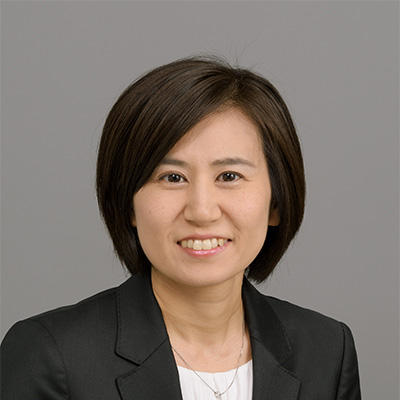
-
Affiliation
-
Faculty of Science and Technology, Department of Applied Physics and Physico-Informatics 基礎理工学専攻 ( Yagami )
-
Position
-
Associate Professor
-
E-mail Address
-

-
Related Websites
-
Remarks
-
Tomoko K. Shimizu
-
External Links

KEIO RESEARCHERS INFORMATION SYSTEM |
Details of a Researcher
このページはJavascriptを使用しています。すべての機能を使用するためにはJavascript を有効にする必要があります。
SHIMIZU, Tomoko
|
|
|
Lawrence Berkeley National Laboratory , Materials Sciences Division, Graduate Student Research Assistant
University of California, Berkeley, Department of Materials Science and Engineering, MSE102 “Crystal Structure and Bonding” Teaching Assistant
Lawrence Berkeley National Laboratory, Materials Sciences Division, Graduate Student Research Assistant
RIKEN, Surface Chemistry Laboraboty, Associate Researcher
RIKEN, Surface Chemistry Laboraboty, Special Postdoctoral Researcher
Keio University, Faculty of Science and Technology, Department of Applied Physics and Physico-Informatics
University, Graduated
University of California, Berkeley, College of Engineering, Department of Materials Science and Engineering
United States, Graduate School, Master's course
University of California, Berkeley, College of Engineering, Department of Materials Science and Engineering
United States, Graduate School, Completed, Doctoral course
学士(工学), Keio University, Coursework, 2002.03
Master of Science, University of California, Berkeley, Coursework, 2004.05
Construction of a Low Temperature Ultra High Vacuum Scanning Tunneling/Atomic Force Microscope
Ph.D., University of California, Berkeley, Coursework, 2007.05
Water Adsorption on Ruthenium (0001) Studied by Scanning Tunneling Microscopy
Nanotechnology/Materials / Thin film/surface and interfacial physical properties
Nanotechnology/Materials / Nanomaterials
Nanotechnology/Materials / Nanostructural physics
Nanotechnology/Materials / Nanometer-scale chemistry
Nanotechnology/Materials / Fundamental physical chemistry
Surface and Interface Science
Scanning Probe Microscopy
Scanning Tunneling Microscopy
Atomic Force Microscopy
Catalysis surfaces
エンジニアのための物理化学
川合眞紀, 宗像利明, 清水智子, 東京化学同人, 2010.01
Original author: JOHN T.YATES, JR.・J.KARL JOHNSON
Probing Local Structural Variations in Metal–Organic Framework Thin Films Using Nano-FTIR
Yukihiro Matsumoto, Kento Takenaka, Hiromasa Sato, Yuto Fujita, Toshiki Sugimoto, Tomoko K. Shimizu
Langmuir 42 ( 22 ) 16052 - 16059 2026.05
Research paper (scientific journal), Joint Work, Last author, Accepted, ISSN 07437463
Yuto Fujita, Norihiko Hayazawa, Maria Vanessa Balois-Oguchi, Satoshi Yasuda, Takuo Tanaka, Tomoko K. Shimizu
Appllied Spectroscopy 80 ( 1 ) 51 - 59 2026.01
Research paper (scientific journal), Joint Work, Last author, Accepted, ISSN 00037028
Simultaneous Ring-Opening and Dehydrogenation of Diarylethene Induced by Tunneling Electrons
Hirokazu Sato, Taehwan Lee, Minhui Lee, Emiko Kazuma, Yousoo Kim, Jaehoon Jung, Kyoung Chul Ko, Tomoko K. Shimizu
ChemPhysChem 26 ( 7 ) e202400988 2025.01
Research paper (scientific journal), Joint Work, Last author, Corresponding author, Accepted, ISSN 14394235
Structure and defect identification at self-assembled islands of CO2 using scanning probe microscopy
Oscar Custance, Emiliano Ventura-Macias, Oleksandr Stetsovych, Carlos Romero-Muñiz, Tomoko K. Shimizu, Pablo Pou, Masayuki Abe, Hironobu Hayashi, Tadakatsu Ohkubo, Shigeki Kawai, Ruben Perez
ACS Nano 18 ( 39 ) 26759 - 26769 2024.10
Research paper (scientific journal), Joint Work, Accepted, ISSN 19360851
Unveiling the surface of carbon black via scanning probe microscopy and chemical state analysis
Mari Isagoda, Yuto Ariyoshi, Yuto Fujita, Sae Endo, Takayuki Aoki, Rui Tang, Hirotomo Nishihara, Tomoko K. Shimizu
Carbon Trends 16 100378-1 - 100378-10 2024.07
Research paper (scientific journal), Joint Work, Last author, Corresponding author, Accepted, ISSN 26670569
Nanoscale characterization of structures and gas adsorption of porous organic thin films
Shimizu, Tomoko K.
学事振興資金研究成果実績報告書 (慶應義塾大学) 2023
Investigation of possibility of single molecule photochromic reactions with plasmonic effect
Shimizu, Tomoko
科学研究費補助金研究成果報告書 2022
Atomic scale investigation of magnetite surfaces towards understanding of its catalytic properties
Shimizu, Tomoko K.
学事振興資金研究成果実績報告書 (慶應義塾大学) 2019
Atomic scale investigation of magnetite surfaces towards understanding of its catalytic properties
Shimizu, Tomoko K.
学事振興資金研究成果実績報告書 (慶應義塾大学) 2018
Tomoko K. Shimizu
Tanso 285 204 - 209 2018.12
Article, review, commentary, editorial, etc. (scientific journal), Single Work, Lead author, Corresponding author
清水智子, Oscar Custance
表面科学 37 ( 7 ) 320 - 325 2016.07
Article, review, commentary, editorial, etc. (scientific journal), Joint Work, Lead author
第2部 計測テクノロジー最前線 第1章 原子一つにせまるテクノロジー 2 原子間の力をはかる -AFM-
清水智子, クスタンセ オスカル
NIMS調査分析室レポート 材料イノベーションを加速する先進計測テクノロジーの現状と動向-物質・材料研究のための先端計測テクノロジー (物質・材料研究機構) 42 - 51 2016.01
Article, review, commentary, editorial, etc. (bulletin of university, research institution), Joint Work
清水 智子
日本化学会研究会「低次元系光機能材料研究会」ニュースレター 10 6 - 8 2016.01
Article, review, commentary, editorial, etc. (scientific journal), Single Work, Lead author, Corresponding author
Tomoko. K. Shimizu
[International presentation] 19th Japan-Korea Symposium on Molecular Science (Tokyo, Japan) ,
Oral presentation (invited, special)
Investigation of the Dynamics of H2O on Fe3O4(111) under Water-Gas Shift Reaction Conditions
Seikai Kurosawa, Akash Aoki, Haruka Matsuda, Yuki Tsujikawa, Hiroshi Kondoh, Tomoko K. Shimizu
[International presentation] 19th Japan-Korea Symposium on Molecular Science (Tokyo, Japan) ,
Poster presentation
Probing Local Structural Variations in Metal−Organic Framework Thin Films Using Nano-FTIR
Kento Takenaka, Tomoko. K. Shimizu
[International presentation] The Japan Society of Vacuum and Surface Science The 2026 Kanto Branch Annual Meeting (Tokyo, Japan) ,
Poster presentation
Nanoscale characterization of wetting using atomic force microscopy
Mayu Inagaki, Taketoshi Minato, Tomoko K. Shimizu
[International presentation] The Japan Society of Vacuum and Surface Science The 2026 Kanto Branch Annual Meeting (Tokyo, Japan) ,
Poster presentation
Signal modification in tip-enhanced Raman spectroscopy under highly localized fields
Yuto Fujita, Norihiko Hayazawa, Maria Vanessa Balois-Oguchi, Takuo Tanaka, Tomoko K. Shimizu
[International presentation] The 10th International Conference on Tip-Enhanced Raman Spectroscopy (Zurich, Switzerland) ,
Poster presentation
磁鉄鉱の室温における水性ガスシフト反応に対する触媒作用の検証と機構解明
独立行政法人日本学術振興会, 科学研究費助成事業, 基盤研究(B), Research grant, Principal investigator
独立行政法人日本学術振興会, 科学研究費助成事業, 基盤研究(A), Research grant, Coinvestigator(s)
磁鉄鉱単結晶およびナノ粒子表面へのガス吸着状態の観察と検証
公益財団法人東京応化科学技術振興財団, 第35回研究助成, Other, Principal investigator
単分子表面分光手法を用いた塵表面における反応素過程の分子レベル解明
文部科学省, 科学研究費助成事業, 学術変革領域研究(A), Research grant, Coinvestigator(s)
走査型プローブ顕微鏡によるカーボンブラック表面の可視化
慶應義塾先端科学技術研究センター, 2020 年度指定研究プロジェクト産学連携支援(単年度), Principal investigator
平成30年度科学技術分野の文部科学大臣表彰若手科学者賞
2018.04, 文部科学省, 分子界面の新規新規機能発現に向けた走査型プローブ顕微鏡の研究
Type of Award: Other
Morton M. Traum Surface Science Student Award Top 5 finalist
2006.11, Surface Science Division, American Vacuum Society
Type of Award: Award from international society, conference, symposium, etc., Country: United States
慶應義塾大学表彰規程による表彰: 成績優秀
2002.03, 慶應義塾大学
Type of Award: Keio commendation etc.
Lucent Technologies Global Science Scholar
1999.07, Lucent Technologies
Type of Award: Other, Country: United States
Verification and Mechanistic Elucidation of the Water–Gas Shift Reaction on Magnetite Surfaces near Room Temperature using Near-Ambient Pressure X-ray Photoelectron Spectroscopy
2026年
APPLIED PHYSICS AND PHYSICO-INFORMATIC PRACTICAL RESEARCH B
2026, Full academic year
LABORATORY IN SCIENCE
2026, Autumn Semester
SURFACE AND INTERFACE SCIENCE
2026, Autumn Semester
SOLID STATE SCIENCE
2026, Spring Semester
PRESENTATION TECHNIQUE
2026, Full academic year
小野圭吾君の博士学位請求論文"層状構造を有する新規熱電材料群143-Zintl相化合物の開発"の副査
, Special Affairs
藤田優人君の博士学位請求論文"高空間分解能探針増強ラマン分光における局在偏光場が誘起するカーボンナノ材料の応答"の主査
, Special Affairs
東伸彦君の博士学位請求論文"銅の格子欠陥を有する複合アニオン層状化合物多結晶LaCu1−δS1−xSexO (x = 0.5 - 0.99) の光学バンドギャップ内構造および熱輸送特性" の副査
, Special Affairs
神川郁海君の博士学位請求論文"ハロゲン化鉛ペロブスカイト太陽電池の結晶配向制御"の副査
, Special Affairs
曽家希美君の博士学位請求論文"遷移金属および複合酸化物におけるスピン流と磁化ダイナミクスに関する研究"の副査
, Special Affairs
American Chemical Society,
次世代ナノプローブ技術委員会委員,
The Japan Society of Applied Physics,
日本表面真空学会,
日本化学会,
プログラム委員, The 16th International Symposium on Atomic Level Characterizations for New Materials and Devices (ALC’26)
関東支部幹事役員, 公益社団法人 日本表面真空学会
協議員, 公益社団法人 日本表面真空学会
プログラム委員, The 15th International Symposium on Atomic Level Characterizations for New Materials and Devices (ALC’24)
関東支部幹事役員庶務担当, 公益社団法人 日本表面真空学会


Click to view the Scopus page. The data was downloaded from Scopus API in September 20, 2026, via http://api.elsevier.com and http://www.scopus.com .