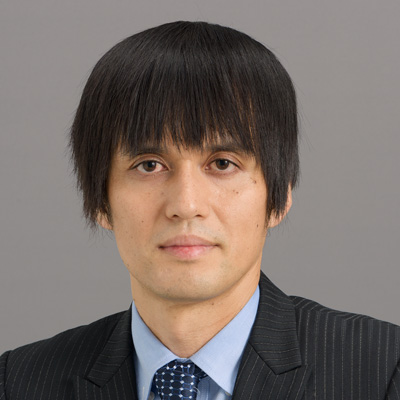
Hasobe, Taku

写真a

Affiliation

Faculty of Science and Technology, Department of Chemistry ( Yagami )

Position

Professor

External Links


Books 【 Display / hide

  • Handbook of Porphrin Science

    HASOBE Taku, World Scientific Publishing Co. Pte. Ltd., 2014

    Scope: Supramolecular Assemblies of Porphyrins and Phthalocyanines Derivatives for Solar Energy conversion and Molecular Electronics

  • 高次π空間の創発と機能開発

    HASOBE Taku, CMC出版, 2013.03

    Scope: 158-165

  • Handbook for Carbon Nanomaterials

    HASOBE Taku, 2012.06

    Scope: 95-130

  • Energy and Electron Transfer Processes in Multiporphyrin Arrays

    HASOBE Taku, 2012.03

    Scope: 499-536

  • 光化学 Vol. 41, No. 3, 157-159 (2010)

    羽曾部 卓・酒井 隼人, 光科学協会, 2010.12

    Scope: 157-159

Papers 【 Display / hide

  • High quantum yield NIR emission via charge transfer states in buckybowl-TPA based D–A systems

    Yakiyama Y., Han J., Sakai H., Hasobe T., Takeda Y., Kishi R., Ohkubo K., Sakurai H.

    Materials Chemistry Frontiers 10 ( 6 ) 938 - 946 2026.03

     View Summary

    The development of highly efficient near-infrared (NIR) emissive materials presents tremendous opportunities across diverse applications, from biological imaging to advanced optoelectronics. While planar aromatic dyes have traditionally dominated this field, we report herein the successful design and synthesis of a novel bowl-shaped NIR dye, TPA-TOS, incorporating the rarely emissive trioxosumanene (TOS) as the acceptor and triphenylamine (TPA) as the donor. In polar solvents, TPA-TOS exhibited weak luminescence confined to the UV region; however, in nonpolar environments, it demonstrated intense NIR emission spanning the 650 to 850 nm range. Remarkably, a quantum yield exceeding 60% in the NIR range was achieved, attributed to an intriguing photo-relaxation pathway. This mechanism involves exciton relaxation from localized excitation to the charge transfer (CT) state, mediated by thermally activated delayed fluorescence (TADF) between CT singlet and triplet states, along with room-temperature phosphorescence (RTP), ultimately transitioning to a long-lived charge-separated (CS) state. The outstanding amphiphilic nature, high quantum yield of NIR dual emission enabled by TADF and RTP, and the generation of a long-lived CS state are likely driven by the pronounced spin–orbit coupling facilitated by the curved sumanene skeleton. This work establishes TPA-TOS as a platform for NIR materials and insights into non-planar photophysics.

  • Observation of Photophysical Processes of a Heptacene Derivative: Monomeric Behavior in Homogeneous Solution and Singlet Fission in Thin Film

    Suzuki S., Sakai H., Yamauchi M., Hayashi H., Mizuhata Y., Kato T., Hirose T., Hasobe T., Yamada H.

    Journal of the American Chemical Society 148 ( 6 ) 6000 - 6011 2026.02

    ISSN  00027863

     View Summary

    A soluble heptacene derivative, 5,9,14,18-tetrakis(triisopropylsilylethynyl)-heptacene (TIPS-Hep), was synthesized in situ from an α-diketone precursor via the Strating–Zwanenburg reaction, and its photophysical properties were comprehensively characterized in both solution and thin-film states. In deoxygenated dilute tetrahydrofuran (THF) solution, TIPS-Hep exhibited monomeric behavior. Absorption peaks were observed at 671, 737, 820, and 970 nm, accompanied by a shoulder at 870 nm, while fluorescence peaks were observed at 894 and 961 nm with a fluorescence lifetime (τ<inf>S</inf>) of <100 ps. Nanosecond transient absorption spectroscopy revealed a triplet lifetime (τ<inf>T</inf>) of 19 μs and a triplet quantum yield (Φ<inf>ISC</inf>) of ∼2%. The short excited-state lifetime in dilute solution was estimated to be 87 ps by femtosecond transient absorption spectroscopy and precludes efficient molecular encounters, indicating that singlet fission is unlikely and that intersystem crossing serves as the dominant pathway for triplet formation. This interpretation is supported by transient decay analysis, which revealed no kinetic signatures associated with SF. In contrast, solution-processed thin films of TIPS-Hep, generated in situ by photoirradiation of a spin-coated α-diketone precursor, exhibited faster and enhanced formation of the triplet excited states. Since multiple excited species are involved, several kinetic models were examined, and a sequential model based on a SF pathway (S<inf>1</inf> + S<inf>0</inf> → TT → 2T<inf>1</inf>) was identified as the most consistent with the experimental results. Global analysis of femtosecond transient absorption data with the sequential SF model assuming three species revealed high yields of correlated triplet pairs (TT, 75% at the maximum value of 100%) and independent triplets (T<inf>1</inf>, 20% at the maximum value of 200%). These results provide valuable mechanistic insights into the excited-state dynamics of higher acenes.

  • Gate-opening cooperative methanol binding to multi-bladed benzenes bearing 1,2-diboryl functionality

    Song Y., Yokoyama H., Shoji Y., Sakai H., Hasobe T., Fukushima T.

    Chemical Communications 62 ( 12 ) 3889 - 3892 2026.02

    ISSN  13597345

     View Summary

    A newly synthesized multi-bladed benzene (2o) bearing two oxaboraanthracenyl and two N-carbazolylphenyl units undergoes highly cooperative binding with multiple methanol molecules (Hill coefficient > 3.5).

  • Conformationally Driven Dual Fluorescence Properties of Higher Heteroacenes With Periodically Incorporated Boron Atoms

    Yokochi T., Yokoyama H., Tsukada T., Sakai H., Hasobe T., Fukushima T., Shoji Y.

    Angewandte Chemie International Edition  2026

    ISSN  14337851

     View Summary

    Hexaboraheptacene (B<inf>6</inf>-hept), featuring a periodic arrangement of boron atoms, together with its shorter homologues tetraborapentacene (B<inf>4</inf>-pent) and diboraanthracene (B<inf>2</inf>-ant), were synthesized via cyclocondensation of o-bis(dihydroboryl)arenes. The reactive boron centers are effectively protected by 2,4,6-triisopropylphenyl (Tip) groups, enabling handling under ambient conditions. As the number of boron bridges increases, the electron-accepting ability as well as the multistep reversible redox properties are progressively enhanced. B<inf>6</inf>-hept exhibits pronounced dual fluorescence in solution, in which relative intensities depend on the excitation wavelength and solvent viscosity. DFT calculations suggest that this phenomenon originates from two interconvertible conformers, namely, the bent-zigzag and twisted forms, which result from a delicate balance between the extended π-system and the steric demands of the Tip groups. This interpretation is supported by the fact that B<inf>4</inf>-pent displays only weak dual emission, while B<inf>2</inf>-ant shows none. This study not only introduces a new class of heteroacenes with potential applications in optoelectronics and electrocatalysis, but also provides insight into steric-design strategies for tuning the conformational landscapes of boron-containing π-systems.

  • Quenching mechanism in rotaxane mechanophores: insights from acene-based luminophores

    Nonaka K., Sakai H., Mori R., Shimada N., Hatatsu S., Hasobe T., Sagara Y.

    Chemical Science 16 ( 45 ) 21534 - 21541 2025.12

    ISSN  20416520

     View Summary

    Rotaxane-based mechanophores that exploit spatial separation between a luminophore and a quencher are attractive due to their high structural design flexibility, enabling high-contrast changes in fluorescence intensity. However, it remains unclear whether their quenching mechanism is predominantly governed by photoinduced electron transfer (PET) or ground-state charge-transfer (CT) complex formation. This study unveils the quenching mechanism using rotaxane mechanophores incorporating π-extended anthracene, tetracene, or pentacene. In toluene, the quenching efficiency decreases with increasing π-conjugation of the fluorophore. Steady-state and transient absorption spectroscopy clarify that the fluorescence quenching of the anthracene-containing rotaxane is primarily due to PET, with a minor contribution from CT complex formation. In contrast, no clear CT complex formation is observed for the tetracene- and pentacene-containing mechanophores. PET moderately quenches the fluorescence for the tetracene-based system, while the low PET efficiency in the pentacene-containing mechanophore results in minimal quenching. Polyurethane elastomer films containing the anthracene-based mechanophore exhibit a significant increase in fluorescence intensity upon mechanical deformation. In contrast, almost no activation is observed for the pentacene-based mechanophore embedded in polyurethane. These findings clarify that PET is the primary quenching mechanism in rotaxane-based mechanochromic mechanophores, offering valuable insights for the future design of supramolecular mechanophores.

display all >>

Papers, etc., Registered in KOARA 【 Display / hide

display all >>

Presentations 【 Display / hide

  • Control of Excite-State Dynamics and Optical Applications of Functional Supramolecular Architectures

    HASOBE Taku

    [International presentation]  University Research Semina (University of Potsdam) , 

    2016.11

    Oral presentation (invited, special)

  • Control of Excite-State Dynamics of Functional Supramolecular Architectures for Optical Applications

    HASOBE Taku

    TUT University Seminar (Tampere University of Technology) , 

    2016.11

    Oral presentation (invited, special)

  • 有機低分子材料のナノ・メゾスケール構造体における励起状態ダイナミクス制御と応用

    HASOBE Taku

    高分子学会 印刷・情報記録・表示研究会および光反応・電子用材料研究会 (東京理科大学 森戸記念館 第1フォーラム) , 

    2016.10

    Oral presentation (invited, special)

  • π共役分子および集積体の励起状態制御と機能性有機-無機複合材料への展開

    HASOBE Taku

    [Domestic presentation]  第49回π造形コロキウム, 

    2016.09

    Oral presentation (invited, special)

  • π共役系分子集積体の励起状態ダイナミクス制御と機能発現

    HASOBE Taku

    九州地区高分子若手研究会・夏の講演会, 

    2016.07

    高分子若手研究会

display all >>

Research Projects of Competitive Funds, etc. 【 Display / hide

  • 材料合成を基盤とした多励起子生成ダイナミクスの新展開

    2024.04
    -
    2027.03

    基盤研究(B), Principal investigator

  • Photofunctional Science of Meso-Hierarchy

    2023.04
    -
    2028.03

    学術変革領域研究(A), Principal investigator

  • 水圏機能材料の励起ダイナミクス制御

    2022.04
    -
    2024.03

    MEXT,JSPS, Grant-in-Aid for Scientific Research, 新学術領域研究(研究領域提案型), Principal investigator

  • 一重項分裂における動的エキシトン解析

    2021.09
    -
    2023.03

    MEXT,JSPS, Grant-in-Aid for Scientific Research, 学術変革領域研究(A), Principal investigator

  • 表面プラズモン効果との融合による一重項分裂のパラダイムシフト

    2021.07
    -
    2023.03

    MEXT,JSPS, Grant-in-Aid for Scientific Research, Grant-in-Aid for Challenging Research (Exploratory), Principal investigator

display all >>

Intellectual Property Rights, etc. 【 Display / hide

  • 内包フラーレンを用いた光電変換装置

    Date applied: P2013-200603  2013.09 

    Date announced: P2015-69731A  2015.04 

    Patent, Joint

Awards 【 Display / hide

  • JPP/SPP Young Invetigator Awards

    Taku Hasobe, 2014.06, Society of Porphyrins and Phthalocyanines

    Type of Award: International academic award (Japan or overseas)

  • SPP/JPP Young Investigator Awards

    2014.06, Society of Porphyrins and Phthalocyanines

  • The Young Scientists’ Prize, The Commendation for Science and Technology by the Minister of Education, Culture, Sports, Science and Technology

    HASOBE Taku, 2010.04, 文部科学省, 光電変換機能を有する分子集合体の創製と応用についての研究

    Type of Award: Other

     View Description

     近年、半導体材料としての利用に大きな期待が高まる有機色素材料は主に真空蒸着やスピンコートといったトップダウン的な薄膜作製法により分子組織化・成膜される。これらトップダウン法の問題点として、分子レベルでの精密な化学結合制御による組織化が困難であることが挙げられる。羽曾部卓氏は超分子的手法の基盤である化学結合制御に基づいた分子組織化に着目し、光電変換機能(光吸収・電荷分離・キャリア移動)を有する分子集合体という新規概念の提唱と創製を行った。実際の特性評価では光電変換効率が最高2%程度まで達し、非組織体と比較して最高50倍という大幅な改善が達成され、同氏の戦略の有用性を定量的に明らかにした。本研究成果は有機材料を用いた次世代の太陽電池など有機エレクトロニクス分野全般への応用が期待される。


Courses Taught 【 Display / hide

  • SEMINAR IN CHEMISTRY

    2025

  • LABORATORIES IN CHEMISTRY 1

    2025

  • INDEPENDENT STUDY ON FUNDAMENTAL SCIENCE AND TECHNOLOGY

    2025

  • GRADUATE RESEARCH ON FUNDAMENTAL SCIENCE AND TECHNOLOGY 2

    2025

  • GRADUATE RESEARCH ON FUNDAMENTAL SCIENCE AND TECHNOLOGY 1

    2025

display all >>


Committee Experiences 【 Display / hide

  • 2015.04
    -
    2017.03

    関東支部常任幹事, 日本化学会

  • 2015.04
    -
    2017.03

    日本化学会代議員, 日本化学会